
Chiba Marina Vestibule Mold
2026/10/27
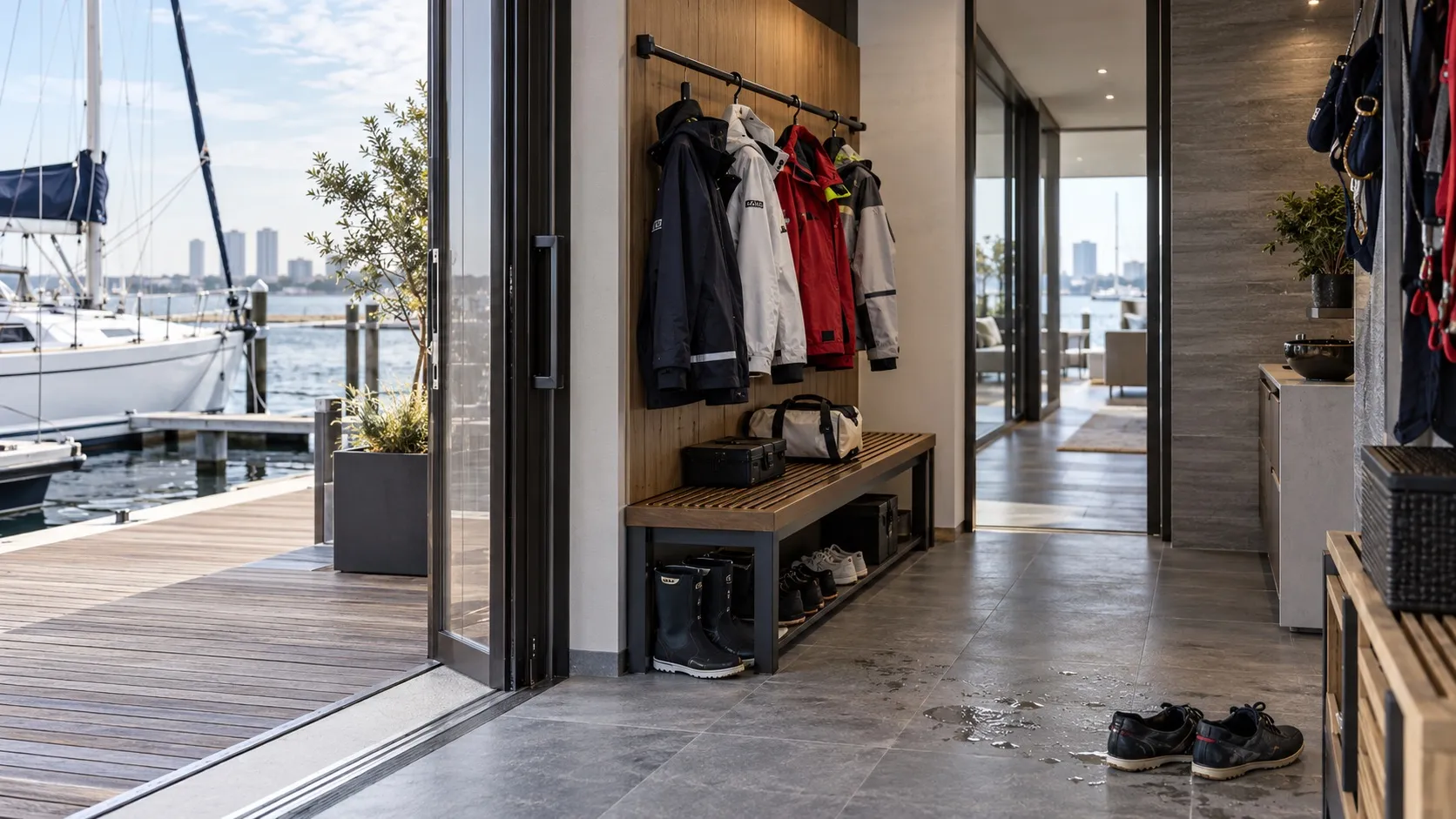
Direct answer: If the equipment vestibule of a marina-side residence in Chiba smells musty or has staining near the door, racks or ventilation equipment, do not assume that “sea air” alone explains it. Separate water brought in on wet sailing gear from rain or splash crossing the exterior threshold, condensation on a cool surface, and a plumbing or HVAC fault. Dry and manage the incoming gear, document the affected building materials, and have the relevant building or HVAC specialist trace any continuing source before mold remediation or finish replacement. Salt exposure can increase corrosion and maintenance needs for some coastal equipment, but it is not a substitute diagnosis for mold or a reason to spray chemicals on the room. Kabibusters Yokohama can be asked in English about a building-side mold and moisture assessment; service scope and timing should be confirmed directly.
This article addresses a specific transition space: the vestibule between a private marina deck, boat access or waterside entrance and the occupied rooms of a high-value home. It is not another general “coastal villa smells musty” guide. That transition space may receive wet boots, flotation gear, coats, ropes and bags. At the same time, it may have a carefully sealed door, washable floor, storage bench, concealed toe-kick, air supply or exhaust, electrical charging point and a door into a conditioned interior. Several moisture routes can meet in a few square meters. A luxury finish does not remove the need to ask where water entered, where it accumulated and whether it can dry.
The US EPA's building moisture-control guide treats entries, walls, plumbing and HVAC as connected design and maintenance questions. Its mold-prevention course says moisture control and prompt attention to hidden wet areas are central to prevention. Japan's Ministry of Land, Infrastructure, Transport and Tourism housing guidance on a humid coastal environment describes separate concerns from humidity, wind and salt exposure in one regional example; it is not a map of conditions at any individual Chiba property. A Daikin manufacturer page on salt-resistant outdoor equipment shows why coastal equipment specifications are a maintenance question for a manufacturer or installer. These sources support a distinction, not a universal claim that a coastal house needs one product or has one cause of mold.
Searches for “marina house wet gear mold”, “coastal entry room damp” and related English terms often return three kinds of result near the top: a surf-club or beach-facility article focused on wet gear, a coastal-home humidity article focused on the whole house, and a product or HVAC article focused on salt-exposed equipment. The first helps identify the use pattern; the second highlights building moisture; the third can inform equipment maintenance. None alone proves why one Chiba vestibule is damp. This is a comparison of the sources' scope and likely gaps, not a fixed ranking or a recommendation to copy a facility design into a private residence. Here the owner needs a room-specific observation log and a coordinated response.
1. Distinguish wet gear from a wet building
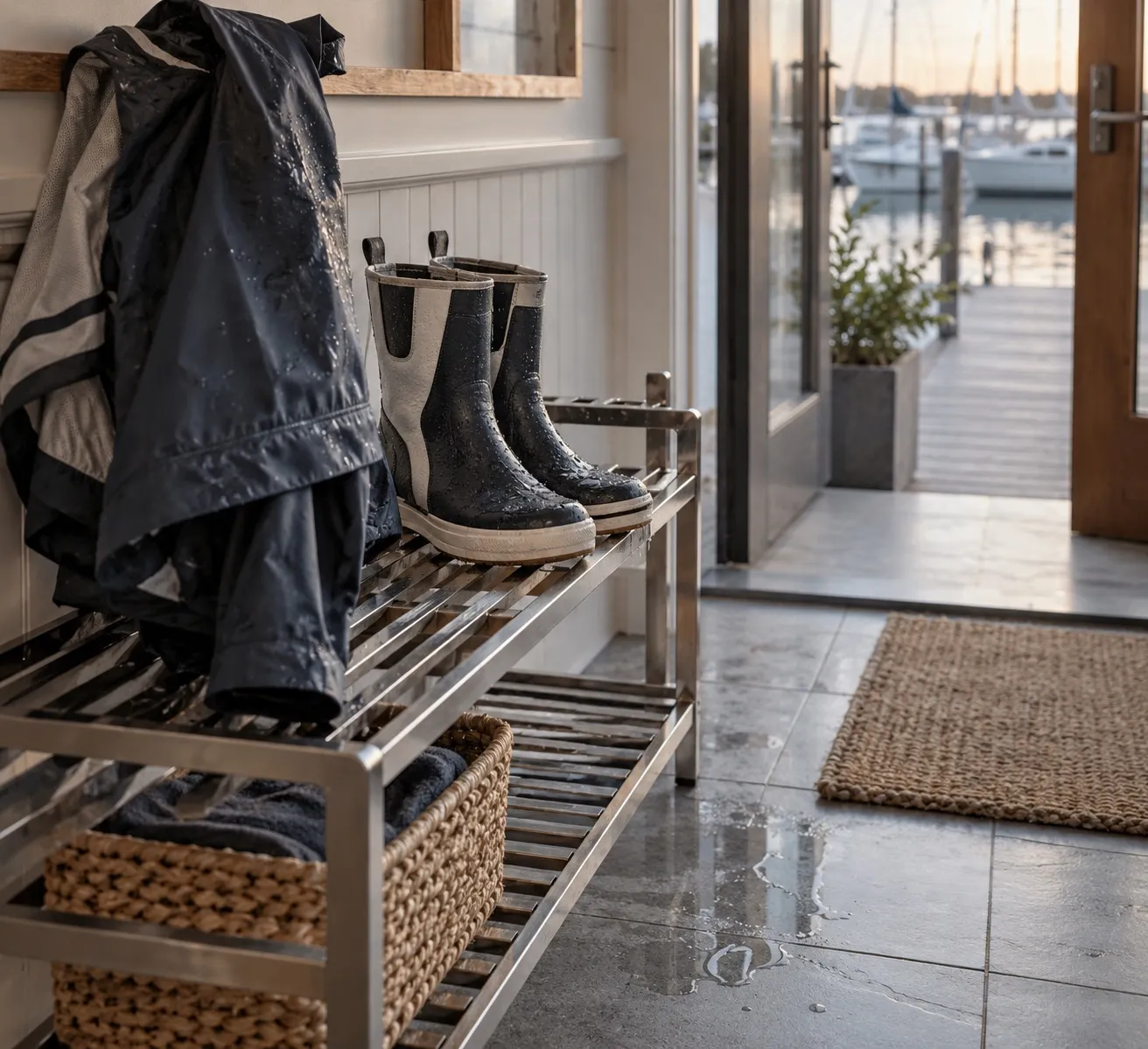
A jacket dripping after a voyage, water tracked by boots, and a wall that re-wets after rain are not the same problem. The first is a predictable moisture load from room use. It calls for an appropriate place to drain, clean and dry gear without soaking finishes. The second is water entry through the exterior envelope or threshold and may require a door, seal, flashing or drainage trade. A damp patch behind a bench can be a third condition: water may have pooled where staff cannot see it, or a cold surface may have condensed humid air. The first step is to observe rather than immediately seal or repaint the area.
Make a floor and wall map with dates. Mark the outside door, inner door, drain, racks, fixed cabinetry, nearby plumbing and HVAC equipment. Record whether the stain appears only after someone brings in wet equipment, after wind-driven rain, after cooling starts or after the residence sits closed. Photograph the same location from the same angle over several events, without disturbing an uncertain growth. Note the material—tile, wood, gypsum board, fabric-backed panel, metal—and whether it feels wet or has swollen. An odor is useful evidence of an issue but does not locate the source or identify a species. A white deposit may be salt, an ordinary finish residue or something else; do not label it “mold” solely by color. Conversely, a corroded hinge does not prove a wall cavity is dry.
The EPA moisture-control guide includes entryways among areas expected to get wet and emphasizes designs and operations that keep moisture-sensitive materials from remaining damp. An appropriately designed washable floor and a gear-drying routine can help manage predictable tracked-in water, but they do not repair failed threshold waterproofing. Ask whether a mat or rack traps water against the wall, whether the floor drains as intended, and whether a concealed cabinet base was built from absorbent material. The answer must be found on site; a photograph of damp boots alone cannot determine how far water has entered a finish.
If standing water is near a charger, socket or electrical cabinet, keep people away and involve a qualified electrician or equipment technician before opening or cleaning. If the vestibule connects directly to occupied rooms, consider a temporary boundary and a safe gear route while investigating. Do not move visibly affected items through the house without a plan. If a storm has caused active entry, stopping the source and protecting people comes before cosmetic cleaning. The manager can gather observations and authorize safe access, but should not replace a physical assessment with a generic coastal checklist.
2. Check the threshold, wall and hidden toe-kick after weather events
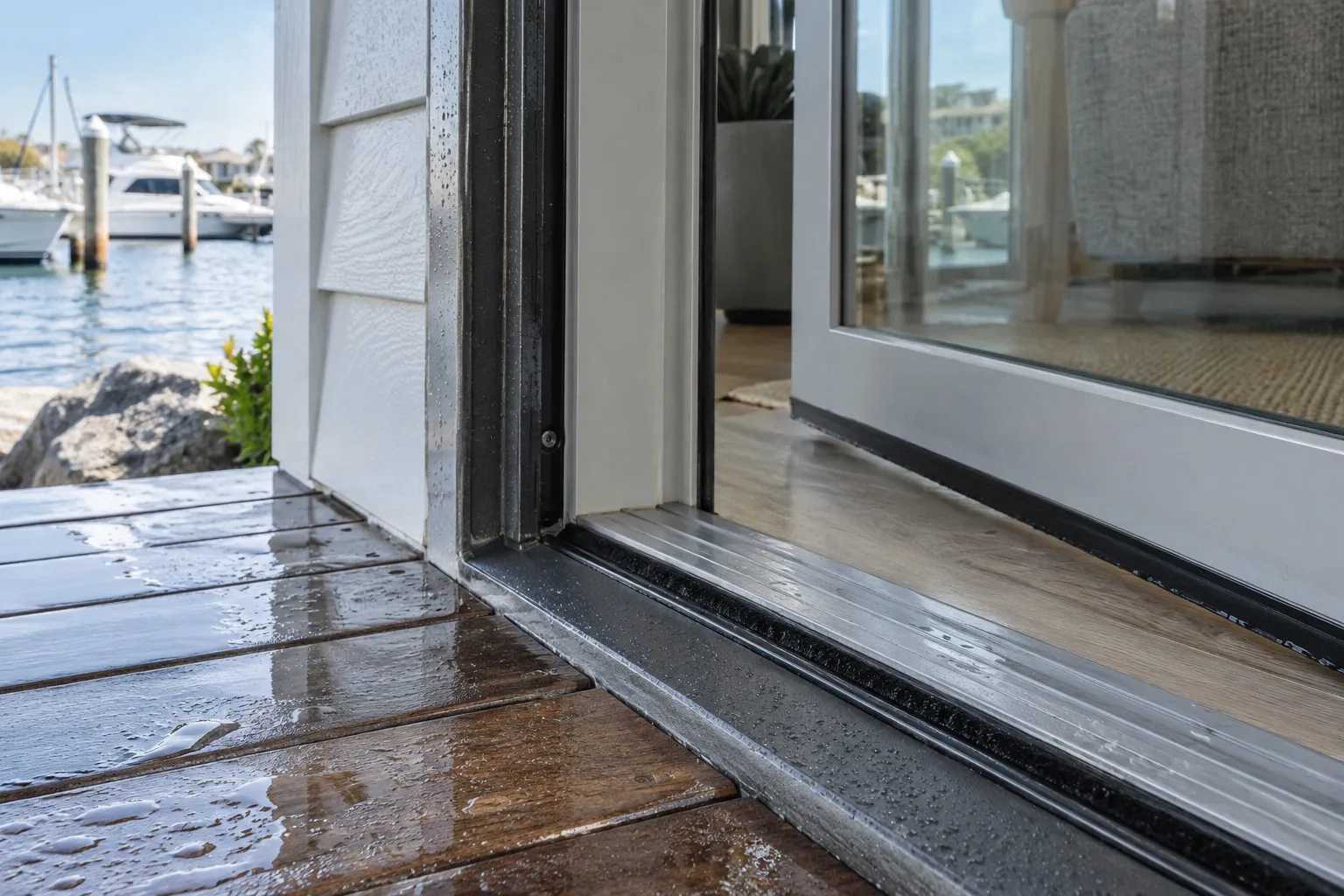
A marina-side entrance can be exposed to wind-driven rain, spray and repeated door use. The site-specific issue is not merely proximity to the sea: orientation, overhang, sill detail, door gasket, exterior drainage, floor level and maintenance history all matter. Water can cross a threshold when the door is open, but it can also find a route through an edge or junction while the door is closed. An exterior seal may look intact from the room but have a hidden gap. A wet interior finish can be caused by a plumbing route or condensation instead. Compare observations with actual weather and use, rather than assuming every stain is rain penetration.
Have the relevant building-envelope specialist examine the door assembly and adjacent wall, not just the visible stain. Ask for a reasoned hypothesis and what inspection would distinguish it from other causes. A moisture meter reading alone can be affected by material, salts and construction; it should be interpreted by someone who knows the assembly. An invasive opening may be justified if a concealed backing is persistently damp, but it should have a scope, protection plan and reinstatement plan approved by the owner. The EPA mold-prevention course specifically highlights hidden areas that may have been wet. For a luxury vestibule, hidden does not mean negligible: a thin toe-kick can conceal a much larger wet contact area behind expensive joinery.
Separate salt and corrosion from mold. The MLIT coastal-housing example treats salt and humid damage as environmental design concerns, and the Daikin manufacturer guidance describes salt-resistant options for an outdoor product category. Neither source establishes that salt crystals on a private vestibule wall are mold, nor that a particular installed unit meets a given coastal specification. If metal hardware or an outdoor unit is corroding, ask the manufacturer or installer about its actual model, site exposure and maintenance instructions. If the interior wall is wet, ask a building-moisture specialist to locate water and assess material condition. These conversations may run in parallel, but they should have separate findings and budgets.
When repairs are proposed, insist on a sequence: stop the source, determine the extent of affected material, remove or clean building material as appropriate, dry and verify, then reinstate the finish. If the manager commissions new cabinetry before understanding the wet path, the defect can be covered up. If the entrance is cleaned without a gear-drying routine, predictable use moisture can return. A durable closeout is the joint result of a sound assembly and realistic operation.
3. Verify ventilation and the path for drying gear
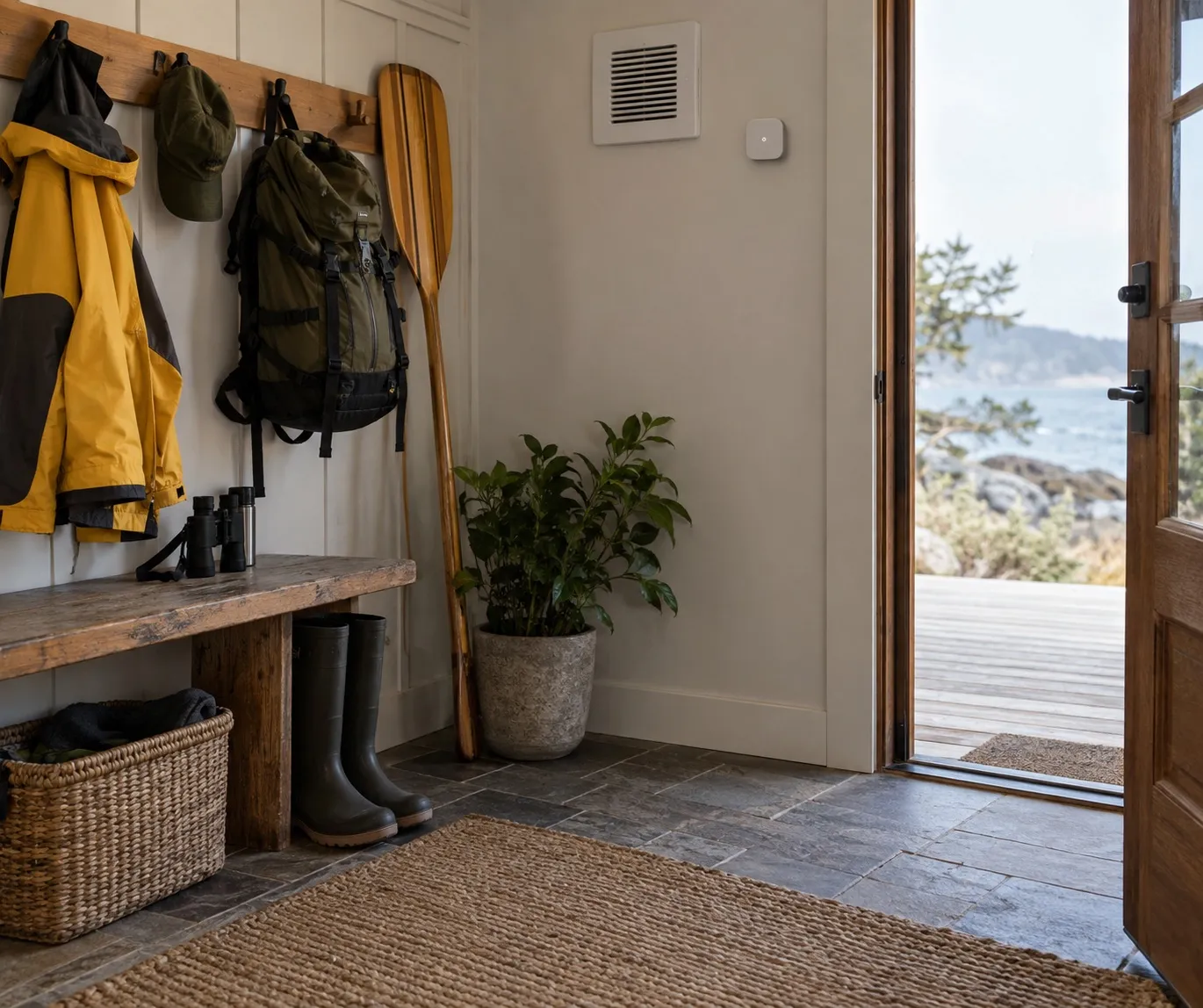
The presence of a grille does not prove that wet jackets and boots will dry without wetting the room. A wall-mounted fan may exhaust only when switched on. A return-air path may be blocked by a solid inner door. An air-conditioning system may cool the space intermittently, while moisture introduced after sailing remains in a closed cabinet. Conversely, inviting humid outside air into a cooled vestibule can create a condensation question. The EPA building moisture guide treats HVAC operation, condensation and moisture sources together. A qualified HVAC professional should verify the actual air path and controls at this specific property; a blog cannot prescribe one fan size or dehumidifier setting.
Ask what happens on a normal return from the marina. Are wet boots placed on a rack or on absorbent timber? Are jackets hung apart so their surfaces can dry? Is there a drain or a way to remove water before it reaches a cabinet? Is there a separate wet-gear drying area, and is its ventilation operating when the home is unoccupied? Does the inner door stay open, changing the airflow to adjacent rooms? Does staff have a written routine for promptly drying surfaces and checking the bench base? These are operational observations, not blame. They make it possible to distinguish a design shortfall from a missed maintenance task and to select a practical remedy.
Temperature and relative humidity readings can help if the sensor location, time and weather are recorded. Compare the open part of the vestibule, a closed storage bay and an adjacent occupied room. A low average humidity at the inner door does not prove the rack backing is dry. A high humidity reading after a wet gear drop is not evidence of mold by itself. Look for persistent wetness, repeat patterns and condition of materials. The EPA prevention course emphasizes prompt drying and routine HVAC maintenance; it does not support declaring a wet room “fixed” merely because one display number improves. Verify condensate drainage and any supply duct or cold surface if the stain appears during cooling rather than after a storm.
| Observation | Most useful first question | Likely lead | Do not assume |
|---|---|---|---|
| Water follows wet boots and jackets | Where can gear drain and dry without wetting finishes? | Manager plus room/HVAC designer | Every damp surface is caused by a wall leak |
| Stain follows heavy rain when gear is absent | Does the door, sill or wall admit water? | Door/envelope specialist | A new fan will repair the seal |
| Wetness appears during cooling | Is there condensation or a condensate fault? | HVAC specialist | It is sea spray without testing |
| Corrosion appears on metal hardware | What is the actual material and exposure? | Manufacturer or installer | Corrosion proves mold in the wall |
| Odor persists after surface cleaning | Is a hidden toe-kick or backing still damp? | Building-moisture/mold specialist | Fragrance is evidence of drying |
This is a decision table, not a remote diagnosis. Multiple rows can apply at once. A room may be exposed to wet gear and have a threshold fault, or a coastal outdoor unit may need corrosion maintenance while the indoor stain comes from a local drain. The quality of the assessment is shown by how clearly the team distinguishes evidence, plausible cause and remaining uncertainty. Do not commission a numeric chart for the article without actual primary measurements from the property or a cited dataset; the table is sufficient to communicate the choices.
4. Coordinate an owner-approved scope and return-to-use check

For an overseas owner, the manager should send a concise brief rather than a series of alarming photographs. Record the room location, visible symptoms, dates and weather, the wet-gear routine, whether active water or electrical risk remains, which area is temporarily out of use and which specialist is needed next. Separate “observed” from “suspected” and “confirmed.” For example, “Water was found under the south bench after a rain event while no sailing gear was stored there” is a useful observation. “Salt air caused black mold throughout the house” is a claim that the same observation cannot support. Use a restricted photo-sharing channel consistent with owner instructions; a blog is not a place to disclose a private property or inventory.
Ask the building team for the water-path hypothesis, inspection method, affected-material map, repair plan, drying evidence and criteria for putting the bench and gear back. Ask the HVAC team for air-path and condensate findings. Ask the equipment manufacturer about model-specific coastal maintenance if salt corrosion is involved. Have one person reconcile these scopes so a door contractor does not close the wall before moisture is assessed, and a cleaner does not move wet gear into the main house. The EPA moisture-control guide supports verifying moisture-control measures during operation and maintenance. A newly painted surface is not the same as a documented dry assembly.
When to seek professional help: Restrict access and contact an emergency trade if water reaches electricity, the floor is unsafe or the building is actively taking in water. Ask a door or envelope specialist when weather-related entry is suspected. Ask a plumber or HVAC specialist when a pipe, drain, cold line, cooling cycle or air path is implicated. Ask a building-moisture/mold specialist when porous finishes, cabinetry or concealed areas stay damp, growth is suspected, or odor recurs after cleaning. Gear-specific cleaning should follow the maker's instructions and be kept separate from building remediation. Do not promise that every premium item can be restored or that one service covers all trades.
FAQ — Is salt air itself mold? No. Salt exposure can affect metal and equipment, while mold requires a suitable damp environment and material. A white salt deposit, corroded fitting and dark organic growth are different observations; each needs appropriate examination. Do not decide from color alone.
FAQ — Should the outside door simply be left open to dry the room? Not necessarily. Weather, security, outdoor humidity and the home's HVAC balance matter. Use a safe, designed drying path and have an HVAC or building specialist evaluate the actual space. An open door during humid conditions may create new condensation.
FAQ — Can staff wipe the visible stain and return the gear? Surface cleaning may not reach a wet backing or threshold junction. Record and stop the source, determine the affected material, dry and verify before the area is returned to routine use. Keep wet gear from contacting absorbent finishes in the meantime.
FAQ — Does a salt-resistant outdoor unit remove indoor mold risk? No. Manufacturer salt-resistant specifications relate to particular equipment and exposure conditions. Indoor moisture and mold still require their own building assessment.
FAQ — What should an English inquiry include? Give the Chiba municipality, the exact room and affected materials, when water appeared, whether it relates to rain or wet gear, any active leak or electrical concern, and photographs that do not reveal unnecessary private information. Ask which building-side assessment is available and what other trade should be involved.
日本語要点: 千葉県のマリーナに近い住宅の前室でカビ臭や濡れがある場合、濡れたブーツ・ジャケットが持ち込む水分、ドア・敷居からの雨水、空調の結露や排水不良を切り分けます。塩分による金属・機器の腐食は別の点検項目です。用具を乾かす運用を整えつつ、壁・床・造作収納の湿りが続くなら専門家が水分経路と隠れた材料を確認し、原因修理と乾燥確認の後に再使用します。東京・神奈川から千葉の別荘を管理する方も、所在地・症状・写真を整理して英語で建物側の相談が可能です。訪問と対応範囲は個別に確認してください。
For a building-side discussion, see Kabibusters Yokohama's service information and contact the Yokohama team about a marina-side room in Chiba. A message can request English support and explain whether an envelope, HVAC or electrical trade may also be needed. Do not treat a generated illustration, a neighboring home's condition or a generic coastal label as proof of what has happened at this property.
----------------------------------------------------------------------
カビバスターズ横浜
住所 :
〒221-0056
神奈川県横浜市神奈川区金港町5-14 クアドリフォリオ8階
電話番号 :
0120-133-199
----------------------------------------------------------------------

