24時間換気とカビの相談
2026/10/09
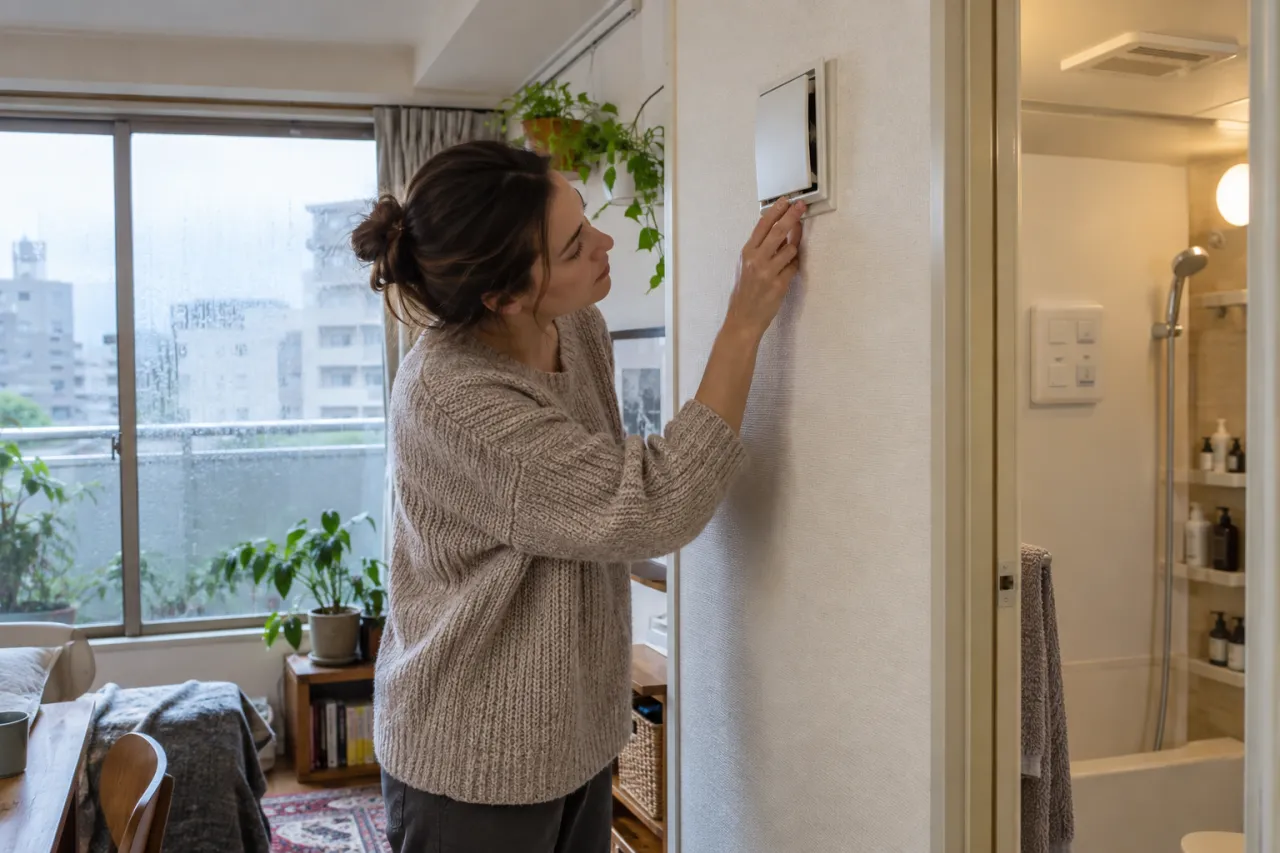
If you have recently moved into an apartment in Tokyo, Kanagawa, or Chiba, you may have noticed a small wall vent or a bathroom button marked 24時間換気. It is easy to mistake that switch for the ordinary bathroom fan, turn it off to reduce noise or cold air, and then wonder why a closet smells damp. The right response is not to blame yourself—or the building—based on the position of one switch. Check how your particular ventilation system is meant to operate, restore its normal setting, document any water damage, and ask the property manager about a fault or blocked airflow. If mold or a musty smell persists, ask for a separate assessment of the affected material and moisture source.
Quick answer: In a home equipped with a 24-hour ventilation system, keep it operating as the building or equipment instructions require and keep its air inlets unobstructed. Do not treat it as a complete mold cure. A running fan cannot repair a leak, dry a soaked wall, or guarantee that air reaches a crowded closet. Record what you observe, safely address immediate water, and contact your manager if the fan is broken, moisture remains, or a rental surface is damaged. Kabi Busters Yokohama can discuss the mold concern in English; the visit area and work scope should be confirmed for your address.
日本語の要点:24時間換気のある住宅では、建物・設備の説明に従って常時運転し、給気口をふさがないことが基本です。ただし、換気だけでは漏水や濡れた建材は直りません。スイッチ、給気口、結露、濡れの場所を写真で記録し、賃貸なら管理会社へ設備不良や水濡れを報告してください。カビの範囲や再発が心配なときは、カビバスターズ横浜に英語で相談できます。
1. What does “24時間換気” actually mean in a Japanese home?
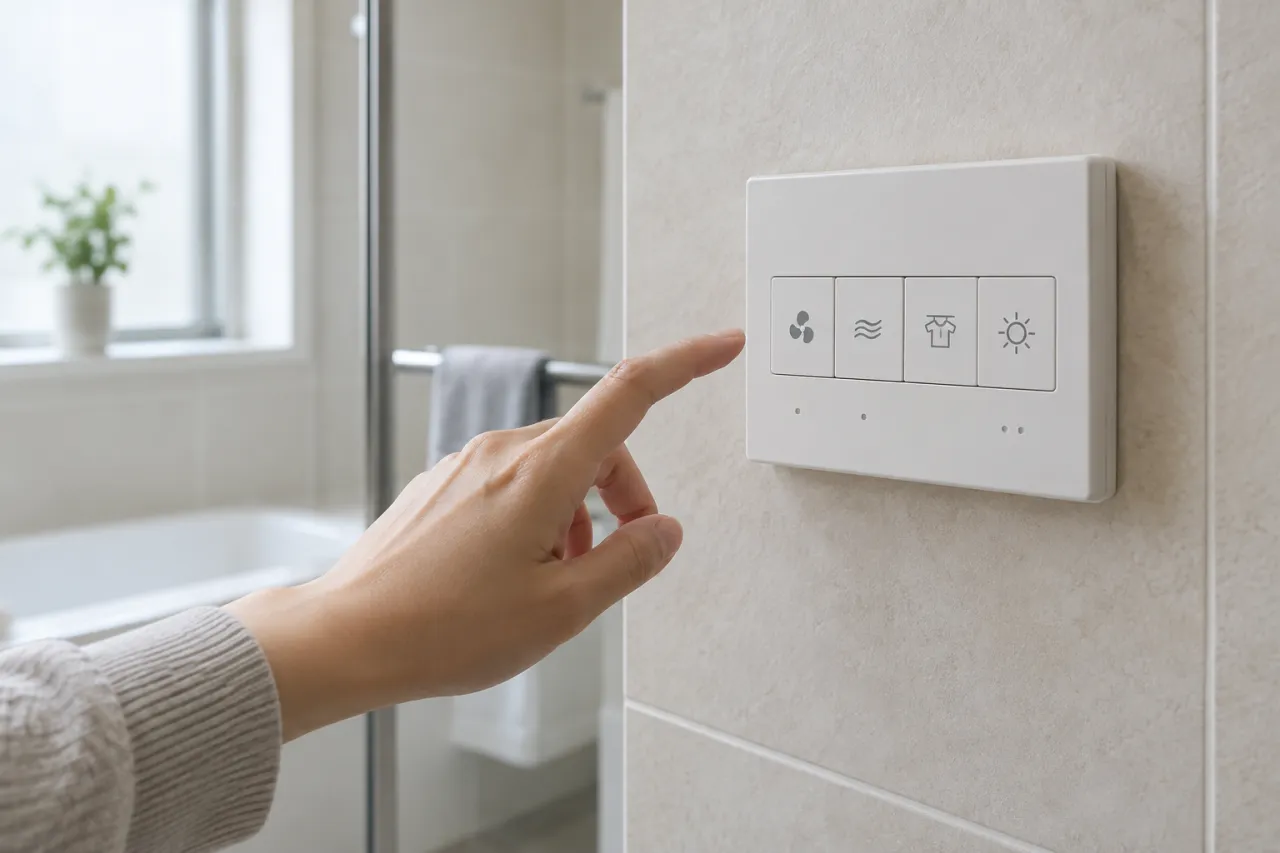
The phrase means “24-hour ventilation,” but the physical system differs between buildings. Some apartments draw air out through a bathroom or toilet fan while outside air enters through wall or window inlets. Other properties have different mechanical arrangements. A control may show a low continuous mode, a stronger temporary mode after bathing, and a separate heater or dryer function. Do not assume that every switch in every building performs the same task. Ask the manager for the equipment manual or a simple explanation of which control is intended to stay on.
The Ministry of Land, Infrastructure, Transport and Tourism's explanation of residential ventilation requirements says that mechanical ventilation is generally required as a measure against indoor-air problems and gives a residential example of at least 0.5 air changes per hour. That design figure is a building requirement, not a measurement of the airflow in your apartment today. A dirty filter, a blocked inlet, a stopped fan, or an altered door undercut may change actual performance. Do not claim that half your apartment's air is definitely replaced every hour without testing the installed system.
Tokyo Metropolitan Government's English indoor-environment FAQ advises keeping a 24-hour system running and also ventilating regularly and circulating air in stuffy storage areas. This is an important distinction for international residents: the system is a background air-exchange measure, not a substitute for removing visible water or inspecting a damp wall. Shinagawa City likewise explains that closing room inlets can prevent the planned ventilation from working and that cooking and bathing add moisture to indoor air. These are public-health and housing-operation sources; none of them can diagnose the dark spot in your own room from a photograph.
If you live in an older building without a control labeled 24時間換気, do not invent a feature that is not there. Ask what ventilation equipment is installed and how it should be used. If you are renting, changing a control, sealing an inlet, or replacing a fan without permission can create a separate property problem. A short question to the manager—“Which switch should remain on continuously, and where should fresh air enter?”—is often more useful than an online rule written for a different building.
2. Check the whole airflow path, not just the fan button
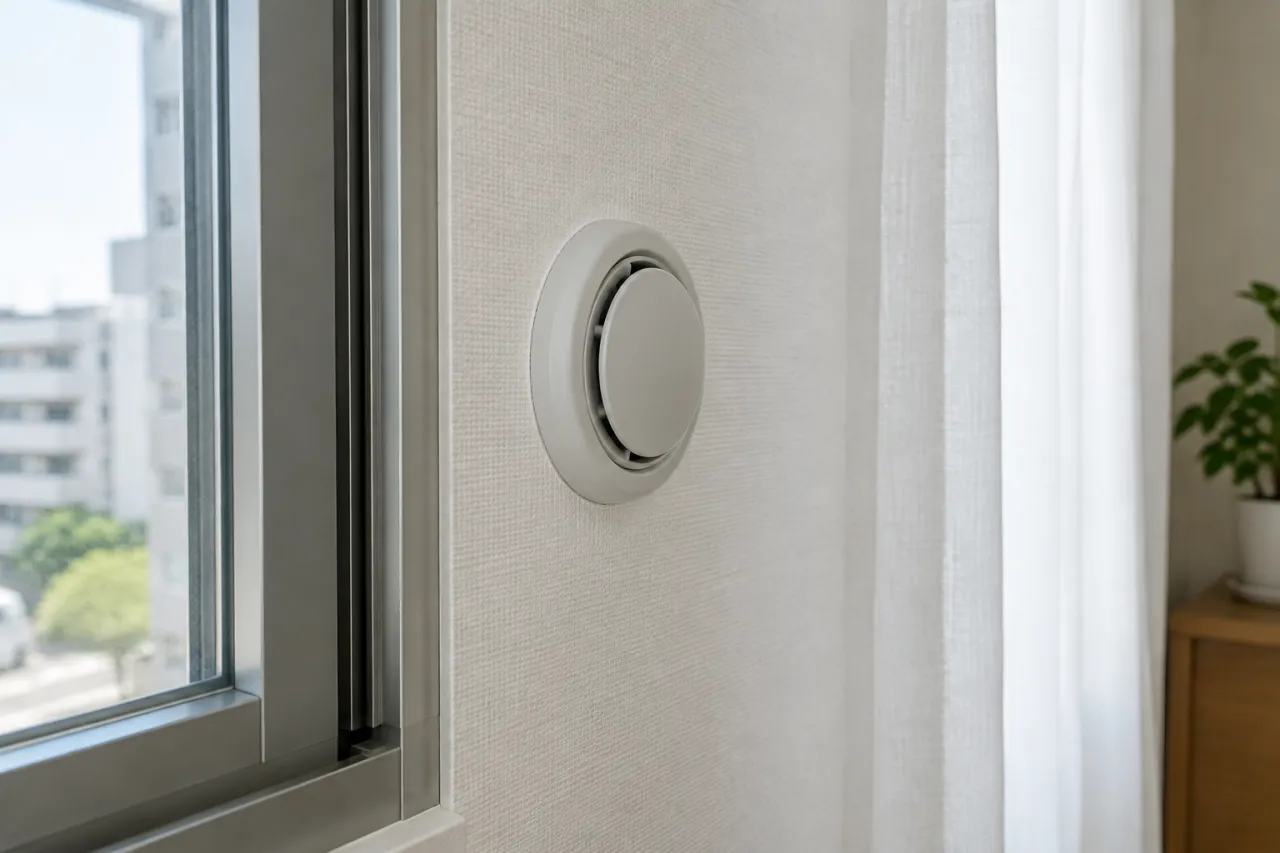
The easiest first check is visual and non-invasive. Photograph the control in its current position, note any indicator light, and listen for unusual noise without putting a hand into a grille. Find the fresh-air inlets shown in the manual or pointed out by the manager. They may be high on a wall, near a window, or integrated with a window frame. Make sure curtains, furniture, tape, and boxes are not blocking an inlet. Check whether an ordinary removable filter is visibly dusty. Do not reach into a powered fan or open a duct. If you cannot identify a part safely, ask the manager to show you.
Why does the inlet matter? An exhaust fan moves air out; replacement air must have a route in. Shinagawa City's official mold-prevention guidance specifically says to keep room inlets open and explains that closing them undermines planned ventilation. The English resident FAQ from Daito Trust Construction similarly tells occupants not to block air vents or stop a 24-hour exhaust fan. The latter is guidance for that company's properties, not a universal instruction to alter every rental; consult your own building's instructions when the equipment differs.
A quick practical inventory can be made without tools: control on or off; inlet open or closed; visible dust at a removable screen; bathroom exhaust grille unobstructed; bathroom door or undercut as designed; damp areas at windows, exterior walls, and closets. Write the date of each observation. If the system appears silent or an indicator does not behave as the manual says, report the symptom rather than declaring the motor failed. A quiet fan may still be running, while a noisy fan may not be moving the intended airflow. Only the manager or a qualified equipment professional can confirm a defect and repair it.
The pattern of moisture helps direct the next question. A wet patch beside a pipe suggests a plumbing or appliance issue. Water on a cold window and adjacent trim may suggest condensation. Dampness behind a wardrobe can reflect limited local airflow, a cold surface, a leak, or more than one cause. The ventilation switch alone does not decide which. Move belongings a safe distance from a wet surface if possible, photograph the location, and keep the manager informed before changing or removing rental finishes.
3. Ventilation, window opening, and dehumidification solve different problems
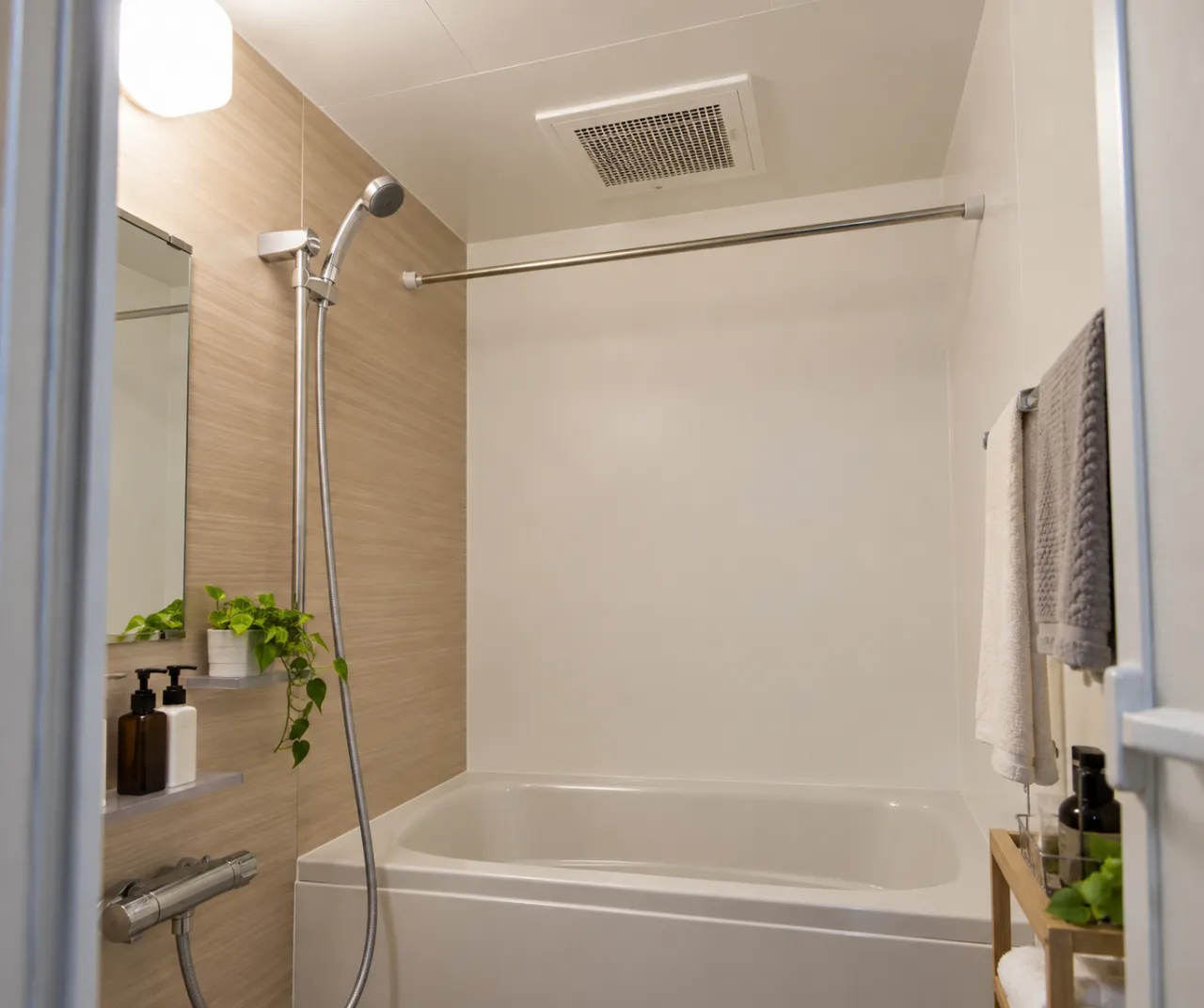
It helps to separate three tasks. Continuous mechanical ventilation exchanges air through the building's designed route. Opening windows can provide additional air exchange when outdoor conditions and building security allow it. Dehumidification removes some moisture from indoor air. None is a substitute for stopping an active water source and drying or assessing a soaked material. In rain or severe weather, opening a window may be impractical; operating a dehumidifier still does not justify covering a blocked inlet or ignoring a leak. The right combination depends on the room, season, outdoor air, and building instructions.
Tokyo's English FAQ recommends using a thermometer/hygrometer to understand the actual room condition rather than humidifying blindly. It says indoor humidity should not exceed 60% in its advice about dust mites. That is a useful monitoring point from a public-health source, not a guarantee that mold cannot grow below one number: condensation on a cold surface can occur even when a meter in the middle of the room looks ordinary. Place the meter where it can be read consistently, record the time and weather, and also look for visible water. A single reading does not measure moisture inside a wall.
After a shower, local steam should be removed. Shinagawa City advises bathroom ventilation after bathing and using an exhaust fan while a gas hob is operating. If the bathroom has a continuous low mode and a temporary strong mode, ask how they interact. Do not switch off continuous ventilation for the rest of the day just because the stronger mode ended, unless the manual instructs otherwise. Dry accessible water on suitable surfaces and keep fabrics from blocking the grille. Avoid balancing on a wet bathtub edge to clean a high vent.
In a closet, the issue is often that air does not circulate around belongings even while the central system runs. Tokyo's FAQ mentions air circulation in closets and other stuffy places. Open doors periodically if safe, avoid pressing luggage or clothing tightly against a damp exterior wall, and check whether the wall itself is wet. If a stain appears on wallpaper, photographs and manager notification come before aggressive scrubbing or painting. A specialist may later need to assess whether there is a material problem, not just a room-air problem.
| Observation | Likely next check | Who to contact first |
|---|---|---|
| Continuous fan switched off; no visible damage | Confirm the correct mode and open air inlets according to the building manual | Manager if instructions are unclear or the system will not run |
| Fan running; window repeatedly wet | Record when condensation occurs, dry safe surfaces, review heating and airflow | Manager if trim or wallpaper stays wet; mold specialist if staining persists |
| Damp patch near a pipe, drain, or air-conditioner line | Check for active water without opening the wall or dismantling equipment | Manager or building emergency repair contact promptly |
| Closet odor or stain despite normal operation | Photograph location, check blocked circulation, note wetness and recurrence | Manager for building condition; mold specialist for affected material |
| Electrical fitting wet or ceiling unstable | Keep clear and avoid touching equipment | Building emergency contact or appropriate urgent service |
This table is a decision aid, not a technical inspection. Do not infer that an occupant caused mold merely because a fan was off once. Likewise, a running fan does not prove the building is free of moisture defects. The observation, repair history, lease, and actual source all matter.
4. If you had the fan off, what should you do today?
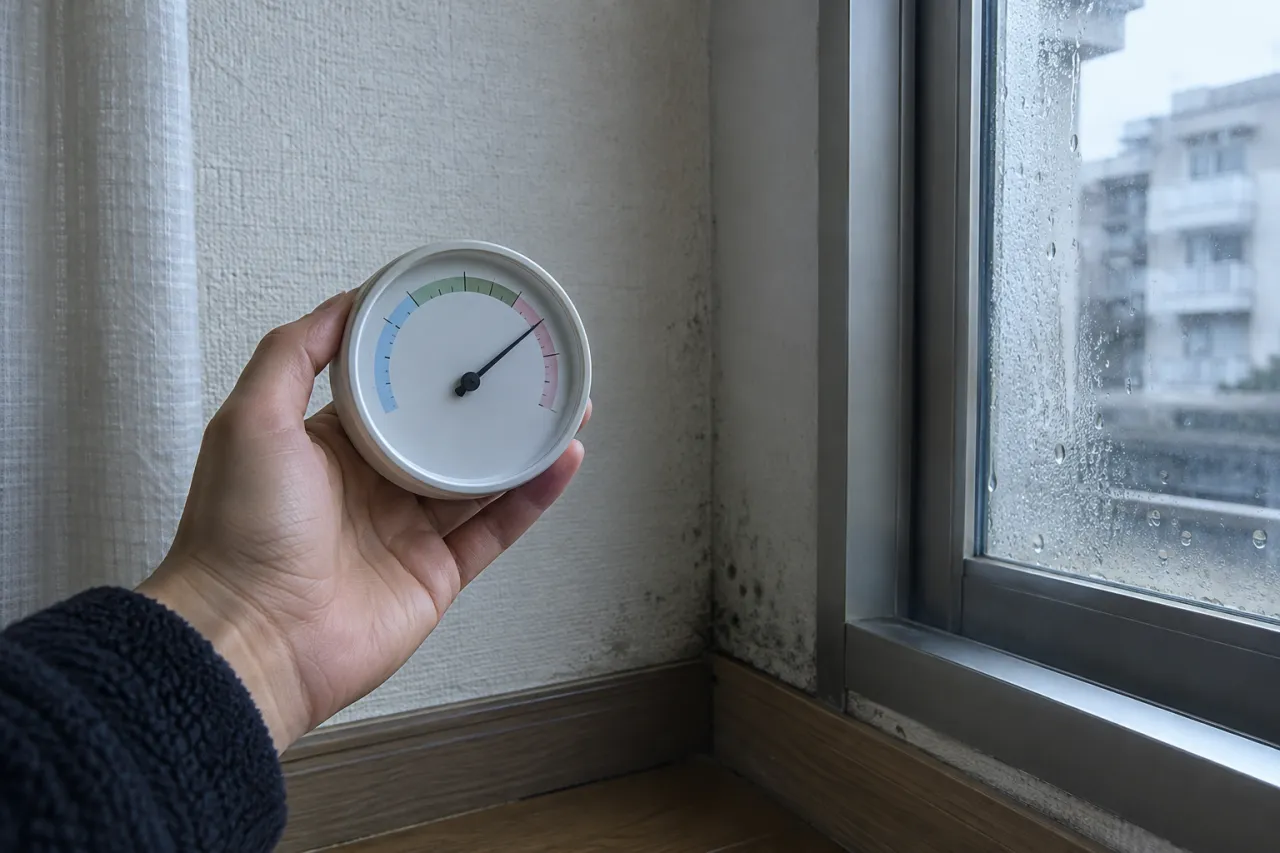
First, restore the system to its normal operating mode using the building's own instructions. If you are unsure which button controls the 24-hour mode, ask rather than experimenting with every setting. Next, inspect visible inlets and remove only ordinary obstructions that you can safely move, such as a curtain or box. Photograph any visible water, staining, or lifting wallpaper before cleaning it. Wipe an accessible wet window or floor if safe, and note what you did. These are sensible immediate actions; they are not a substitute for a repair if a wall remains wet.
Second, create a simple timeline. Record when you noticed the fan was off, whether you know how long it had been off, when the stain or smell was first seen, and whether it changed after restoring ventilation. If you do not know the duration, say so. Do not state that “the fan caused the mold” or “the building caused the mold” as a conclusion that you cannot support. If the area is a rental, send the manager photographs and ask whether an equipment inspection or moisture investigation is needed. Prompt and accurate communication is more useful than a guess about blame.
Third, identify the actual affected material. Is the dark mark on a washable tile, painted wall, wallpaper, wood trim, or ceiling panel? Is it dry, tacky, swollen, peeling, or crumbling? Do not peel paper or open a cavity to find out. Different materials require different approaches, and a damp porous wall may need a building repair before any mold treatment. If the spot is broad, recurrent, hidden behind a fixed fitting, or accompanied by strong odor, it is reasonable to seek technical mold advice after addressing active water and rental permissions.
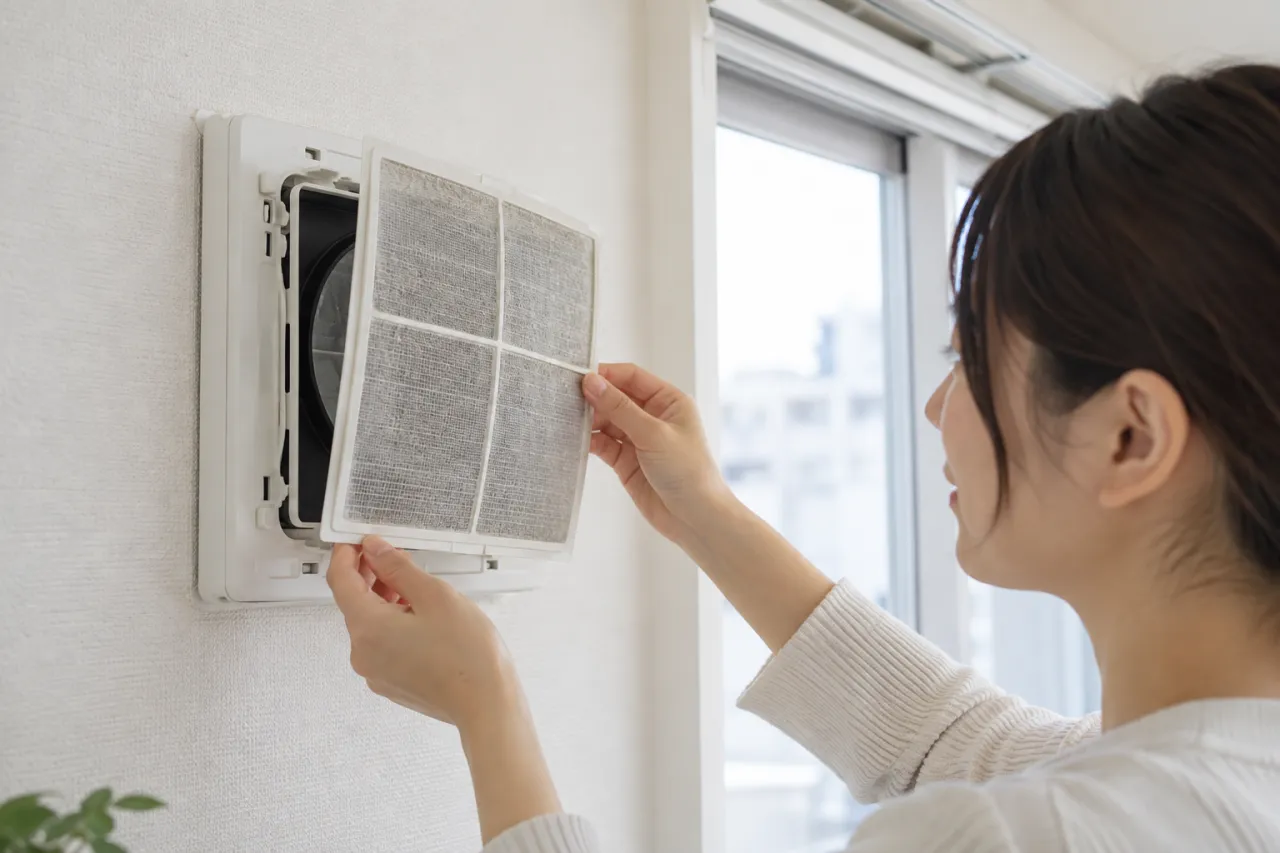
If the fan itself is noisy, vibrates, has stopped, or shows an error, report that equipment symptom to the manager. Do not attempt electrical or duct work. Ordinary cleaning of a user-removable filter should follow the manufacturer or building manual; if there is no clear instruction, ask. Dust buildup is relevant to airflow, but cleaning a filter does not fix a failed motor or a leak. Keeping photographs before and after a safe cleaning step can help everyone see what was changed.
For an English-speaking tenant, a concise manager message is enough: “I live in unit [number]. I noticed on [date] that the 24-hour ventilation setting was off / the fan does not appear to operate. I have returned it to the instructed mode where possible. I also found dampness or a dark mark at [location], photographed today. Could you confirm the correct operation of the system and arrange an inspection of the equipment and moisture source if needed? Please advise before I do any work on the wall.” A simple Japanese version is: 「[部屋番号]で24時間換気の設定・動作について確認したいです。[日付]に[場所]の湿り・黒ずみも見つけ、写真を添付しました。設備の使用方法と、水分の原因の点検についてご案内ください。」
5. When to ask Kabi Busters Yokohama about mold in English
The property manager or owner is the first route for a broken rental ventilation system, a pipe, a roof, or authorization for building work. A mold specialist has a different role: assessing visible or suspected mold conditions, affected materials, and a suitable treatment approach after water entry and permissions are considered. Do not hire someone to dismantle a rental wall without the necessary consent. Conversely, if a fan is running but a black patch expands or odor persists, “just run the fan” is not a complete investigation.
Kabi Busters Yokohama's service description and consultation process explain its mold-related service. The Yokohama team has confirmed that it can respond in English. To make an inquiry useful, state your city in Tokyo, Kanagawa, or Chiba; whether the property is rented or owned; the affected room and material; whether water is still present; what you have already told the manager; and what the ventilation system is doing. The team can then tell you whether an assessment is appropriate and whether your location and situation are within its service scope. Do not assume an automatic visit, fixed price, guaranteed result, or same-day emergency repair.
The contact form allows a description and an optional current-condition photo. You can write the description in English. For example: “I live in [city/prefecture]. My apartment has a 24-hour ventilation switch; it was [off / not working / running]. I found [dark staining / damp wallpaper / musty odor] at [location] on [date]. The property manager has [been notified / approved an inspection / not yet replied]. Could you advise whether mold assessment is appropriate and whether you can support this area? English communication is preferred. My available call times are [times].” Attach photos of the whole area and close-up if the form permits, without showing private documents or other people's personal details.
If there is an active leak, water near wiring, or an unstable ceiling, use the building emergency contact or an appropriate urgent repair service first. If you have health symptoms, ask a medical professional; this blog cannot diagnose them. If a dispute about repair costs or a security deposit develops, seek tenancy advice separately from mold assessment. Clear roles protect both the resident and the property.
6. Frequently asked questions about 24-hour ventilation and mold

Q: Should I leave the 24-hour ventilation on in winter or while away? Follow the installed equipment and building instructions. Tokyo's official English FAQ advises keeping a 24-hour system running continuously; Shinagawa City says room inlets should remain open year-round. A temporary strong exhaust setting after bathing is a separate question. If cold air or noise makes the system difficult to use, ask the manager whether a filter, inlet, fan fault, or correct operating mode needs attention rather than simply taping the inlet shut.
Q: Is 24-hour ventilation the same as air conditioning? No. They may both move air, but the designed purpose and airflow path differ. Cooling, heating, or a dry mode on an air conditioner does not necessarily replace the building's fresh-air ventilation. Ask for the manual if your apartment has integrated controls.
Q: If the fan is running, why is there still mold near a window? A cold surface can collect condensation; a local corner can have limited airflow; a leak can wet a material regardless of the fan. Record when the water appears and which surface remains damp. Persistent or damaged materials need assessment rather than a stronger claim that ventilation “failed.”
Q: Do I have to buy a humidity meter? A simple meter can help you track room conditions, as Tokyo's English FAQ recommends checking temperature and humidity before changing humidification. It is not a wall-moisture instrument, a mold test, or proof of responsibility. Visual water and material damage still matter.
Q: Can I clean a dark patch before telling the manager? If it is a rental, photograph the area and report the condition promptly, especially if the material is wet or damaged. Safely remove standing water where needed, but avoid harsh chemicals on unknown wallpaper, painting over the patch, or opening the wall. Ask for the cleaning and inspection sequence.
Q: Can Kabi Busters Yokohama communicate in English? Yes, English support has been confirmed for the Yokohama team. Provide the location, property type, affected area, moisture history, and photographs in the inquiry. The team can confirm service availability and next steps for your particular Tokyo, Kanagawa, or Chiba address.
The practical order is: identify your building's intended ventilation mode; keep its air path unobstructed; record moisture and material changes; notify the manager about faults or damage; and seek mold-specific advice if the problem persists or the material needs assessment. The ventilation system is part of prevention, not a verdict about cause or blame. If you would like to discuss the mold concern in English, use Kabi Busters Yokohama's inquiry form after the urgent building issue and rental permissions are addressed.
Primary sources / 参考資料
- Ministry of Land, Infrastructure, Transport and Tourism: residential ventilation requirements
- Tokyo Metropolitan Government: indoor environmental management in English
- Shinagawa City: official mold prevention and ventilation guidance
- Daito Trust Construction: English resident guidance on vents, fans, and mold
- Leopalace21: English resident guidance on 24-hour ventilation and mold prevention
----------------------------------------------------------------------
カビバスターズ横浜
住所 :
〒221-0056
神奈川県横浜市神奈川区金港町5-14 クアドリフォリオ8階
電話番号 :
0120-133-199
----------------------------------------------------------------------