Mold in Estate Staff Quarters
2026/10/20

Direct answer: If a bedroom or small apartment used by live-in staff in a private residence smells musty, has recurring condensation or shows water staining, treat it as an occupied living space—not a back-of-house cosmetic defect. Ask the resident to report the location and any active leak through a clear, private channel. Address urgent water or electrical hazards first, arrange a building-side investigation of the moisture source, and decide whether temporary alternative accommodation is needed while the space is assessed. Do not cover the wall, spray a fragrance or require the resident to keep sleeping beside visibly affected material. A mold professional may assess the affected indoor building materials, while a plumber, roof specialist, HVAC technician or other qualified trade must resolve the underlying water route. An article cannot determine a Japanese employment or tenancy obligation for a particular household; check the actual agreements and obtain appropriate local advice where necessary.
This guide is written for overseas owners, estate managers, executive-household offices and English-speaking residents who manage private homes in Tokyo, Yokohama and wider Kanagawa, or Chiba. The search question is narrower than “how to clean mold from a bedroom.” Staff quarters may be within the same structure as the owner's home, in a service wing, or in a separate on-site building. They can have their own kitchenette, bathroom, air-conditioning and access route. A concern may be reported first to a housekeeper, security lead or property manager rather than the owner. That reporting chain must not make a resident wait until a VIP visit or expose personal health details to unrelated staff. No one should assume that the visible patch is the full extent of the problem or that a staff member caused it by ordinary daily use.
Three highly relevant search resources answer different parts of this question, but none describes this exact Japanese private-estate arrangement. The UK government's damp-and-mould guidance for accommodation providers focuses on accessible reporting, prompt investigation and communication with occupants. The US EPA's remediation guide for building managers explains source control, planning, material assessment and communicating with occupants. The US NIOSH workplace-mold overview explains why dampness observations deserve attention and offers a building-assessment approach. The UK and US pages are technical or management references, not Japanese law. For any question about the actual repair or management arrangement of a rented unit, consult the contract and the Japanese Ministry of Land, Infrastructure, Transport and Tourism's rental-housing management information as a starting point, then obtain case-specific advice. A company-provided room may not have the same arrangement as an ordinary tenancy.
1. Make reporting safe, private and actionable for the resident

The first useful report is factual and limited: “The north bedroom wall has a musty smell and a new stain behind the bedside cabinet; it became worse after last night's rain.” The resident should be able to send a photo from a safe position, note the date and say whether water is actively entering or touching an electrical fitting. The manager should acknowledge receipt, name a contact person and explain the next inspection step. An English-speaking employee should not have to translate a technical diagnosis or argue with a supervisor about whether a stain is “real mold.” A Japanese-speaking caretaker can receive the same simple checklist. The communication route should be accessible without sharing the resident's medical history with the whole household.
The UK accommodation guidance recommends easy-to-use reporting processes, including for people who face barriers to reporting. It also recommends that staff and contractors can report damp conditions they encounter. That principle is particularly useful where the resident works for the owner: the person affected should not need permission from a department that is responsible for causing or repairing a leak before the report is recorded. However, the guidance does not decide contractual rights in Japan. The estate's manager should document the arrangement rather than assuming the foreign guidance applies as law.
Preserve privacy in both directions. A mold investigator needs safe access to the relevant room, utility spaces and possibly adjacent building assemblies. They do not need the owner's guest list, security codes, valuables inventory or the resident's unrelated personal belongings. Agree a suitable visit time with the resident; give notice through the appropriate contractual or management process. Ask before moving furniture and photograph building conditions rather than private papers or clothing. If an emergency leak requires immediate access, document why the emergency process was used and who entered. Avoid posting room photos in an open household group chat.
What if the resident reports symptoms? Do not diagnose an illness from a photo or an air-test result. Encourage the resident to seek medical advice from a qualified healthcare professional, especially if breathing difficulty or other concerning symptoms are present. The building team should focus on water, affected materials and safe access. The NIOSH overview of mold in the workplace describes associations between damp buildings and respiratory problems; it does not prove that one room caused a particular individual's illness. Record the environmental complaint without demanding the resident disclose medical details to the contractor.
For the first response, ask five questions: Is there an active leak? Is electricity, ceiling stability or structural integrity affected? Does the resident have another safe place to sleep if inspection or drying is disruptive? Who is authorized to approve opening a wall or replacing finishes? And who will tell the resident when and how the next decision is made? This is a practical triage list, not a universal legal rule. If water is near electrical equipment, a ceiling is sagging, or substantial material is loose, restrict access and use the appropriate emergency trade before a routine mold visit.
2. Investigate the water pathway before choosing a cleaning method

A visible dark mark does not identify the source. Staff accommodation may sit under a roof valley, beside a service pipe chase, above an unheated garage or behind a laundry or shower. Water can arrive from a leaking fitting, failed exterior seal, rainwater entry, intermittent HVAC condensate or condensation on a cold surface. Multiple causes can coexist. The manager should make a simple room plan, mark the stain, record whether it changes with rain, bathing, laundry, cooking or cooling, and identify the assemblies that cannot be inspected without opening them. A surface moisture meter can help map a pattern, but it cannot on its own identify a hidden pipe or prove that a wall cavity is dry.
The EPA building-remediation guide puts identification and repair of the moisture cause before successful remediation. It also advises evaluating hidden mold when the evidence warrants it and revising the plan if concealed conditions are found. Therefore, a contractor's proposed one-hour surface wash should be treated as a narrow cleaning offer, not as proof that a recurring stain is solved. Similarly, a dehumidifier may make the room feel better for a while without repairing a roof or pipe. Record temporary moisture-control measures separately from the permanent source repair.
Trace the building system logically. If the stain follows rainfall, inspect accessible roof, gutter, wall and window routes, and ask the appropriate envelope specialist to assess the assembly. If it follows shower use, include plumbing and waterproofing. If it appears during cooling, check condensate drainage, duct or pipe insulation, airflow and cold-surface condensation with an HVAC specialist. In a detached staff cottage, site drainage and ground-level moisture may be relevant. Do not direct a general cleaner to open energized equipment, remove structural material or alter a waterproofing detail. Those are different professional scopes.
When an overseas owner asks for a remote decision, send an evidence packet rather than a dramatic close-up. Include a wide photo that locates the mark, close photos with date and scale, rain or use history, accessible moisture readings with instrument details, an inventory of affected material, and a list of areas not opened. State “observed,” “suspected,” and “not yet checked” separately. A suspect spore type or an attractive photo should not drive the scope ahead of source identification. Avoid using generated illustrative images as evidence of this estate's actual condition; only dated on-site photographs belong in the case record.
When is outside expertise justified? A recurring stain, water-damaged porous wall or ceiling material, persistent odor after drying, concealed cavity, unclear water route, or a resident who must remain in an occupied space is a stronger reason for qualified investigation than a small, isolated spot on a hard, nonporous surface with an obvious and corrected cause. This is a decision framework rather than a fixed numerical threshold. Ask the proposed assessor what they will inspect, what they cannot inspect, and which separate trades will repair the source.
3. Separate occupant accommodation, source repair and mold work
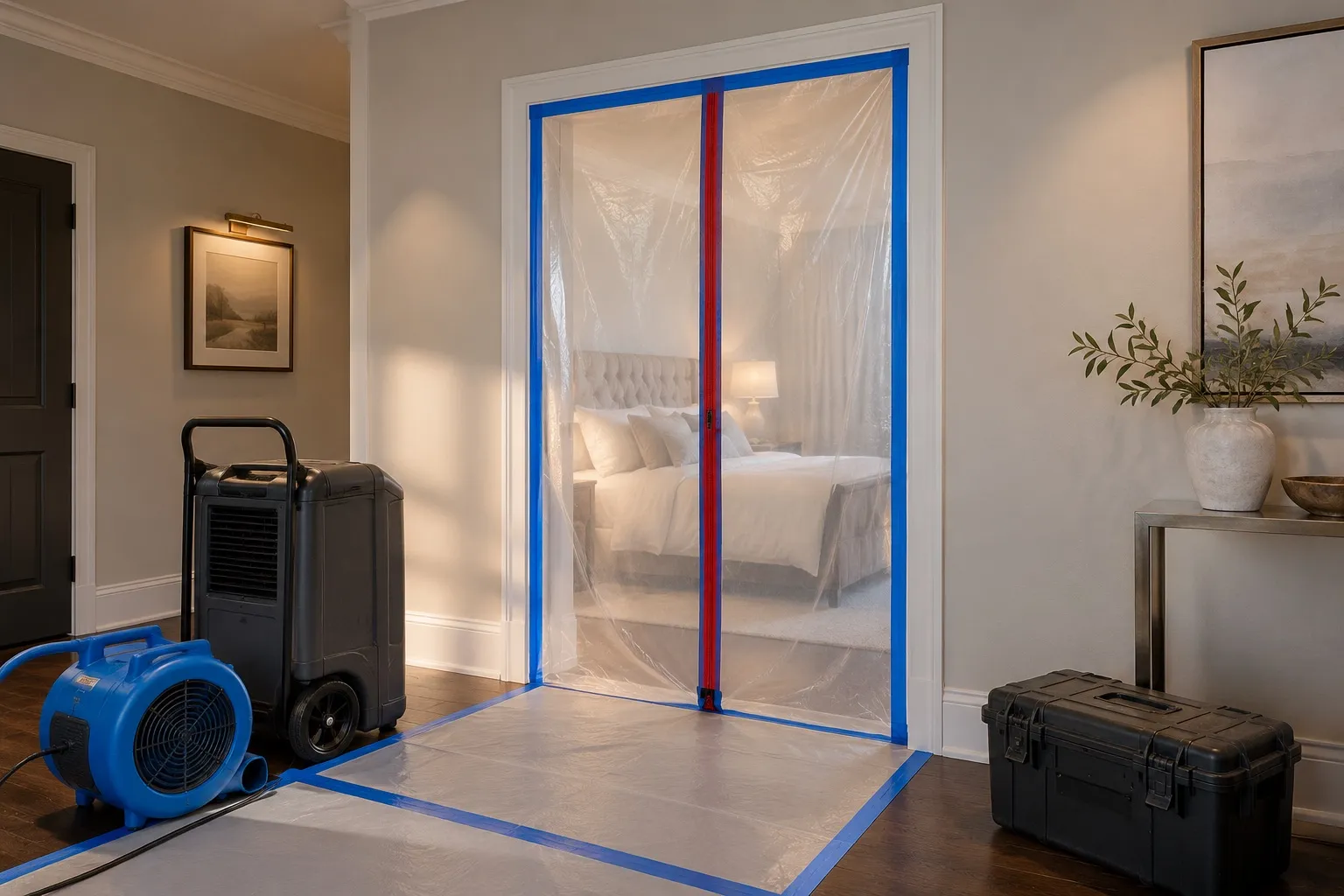
The estate manager should run three tracks in parallel. First, protect the resident's immediate use of the room and agree an interim arrangement if water, demolition or drying makes it unsuitable. Second, assign the relevant building trade to stop the moisture source. Third, assess and address affected interior materials so the source repair is not covered by a cosmetic finish. These tracks can overlap, but none replaces the others. A room relocation alone leaves the building problem; a new roof tile alone may leave wet gypsum board; a mold treatment alone does not fix the leak.
The EPA remediation guidance distinguishes types of material and acknowledges that porous materials with mold growth may be difficult or impossible to clean completely. It also covers containment and protective equipment appropriate to a planned remediation. The extent and method depend on the actual building and professional assessment. Do not ask a housekeeper to scrub a large or hidden problem beside an occupied bed. If the wall is to be opened, the contractor should explain dust control, protection of adjacent rooms, waste handling, and how the space will be dried and checked before reinstatement. Staff belongings should be handled with the resident's consent and a clear inventory, especially passports, computers or personal textiles.
| Observation or decision | Lead contact | What to confirm | Shortcut to avoid |
|---|---|---|---|
| Active water, wet socket or sagging ceiling | Estate manager and emergency trade | Isolation, access restriction and source control | Sending a cleaner into an unsafe room |
| Stain tracks rainfall or exterior wall | Building-envelope specialist | Roof, window, flashing or drainage route | Painting over the inside wall |
| Stain tracks shower or laundry use | Plumber/waterproofing specialist | Supply, drain and wet-area detail | Assuming the resident ventilated poorly |
| Odor or growth-like material in porous assembly | Mold/building-material assessor | Affected extent, safe opening and remediation scope | Spraying a visible surface only |
| Resident cannot use the room during work | Manager and resident | Interim accommodation and communication | Treating a service room as unoccupied |
| Valuable owner or resident property nearby | Owner/resident and item specialist | Consent, protection and separate item assessment | Promising full restoration of objects |
The table assigns first responsibility, not a legal conclusion about who pays. Written employment, license-to-occupy, lease and management agreements may differ. The MLIT rental-management overview explains Japan's rental-management framework, but it does not resolve an individual staff housing dispute. If responsibility, access or relocation costs are contested, refer the documents to a suitable Japanese adviser. A contractor should not arbitrate employment questions to sell a cleaning job.
For a discreet VIP property, approvals should be precise. The owner may authorize an initial survey, the manager may coordinate access, the resident should know what will be examined, and the relevant trade should approve work within its own competence. Ask for a written change-control step if a limited inspection finds wider wet material. A request to “make the room perfect before next weekend” is not a technical scope. State which surfaces and cavities were investigated, what remains unknown, who fixed the source, and whether normal use has resumed. Privacy does not require concealing findings from the person living in the room.
4. Close the case with evidence, not a cosmetic photograph

After source repair and material work, walk through the affected area against the original location plan. Confirm that the active leak was corrected, affected materials were assessed and treated or replaced as appropriate, and the area is dry under the conditions in which it will be used. Consider whether another rain event, shower cycle or cooling period is needed to test an intermittent source. Record the limits of that verification. One odor-free day is not a guarantee against every future leak; one photograph of a clean wall cannot show the condition behind a sealed panel. The EPA guide emphasizes checking for recurrence of moisture and mold after remediation.
The resident should receive a plain-language account of the work relevant to the living area: source found or still uncertain, dates of intrusive work, what was removed or repaired, what follow-up remains and whom to contact if staining returns. The owner can receive a separate management report with costs and contractor details. These are not identical documents: the resident does not need private estate security details, and the owner does not need the resident's unrelated personal information. If a room remains under investigation, say so and avoid implying that a cosmetic finish certified it safe.
FAQ: Is staff housing different from a guest bedroom? Yes in operational terms: someone may sleep there every day and may be less able to challenge a manager's decision. This article does not determine the legal status of a particular room. Treat the occupant's report seriously and check the actual agreements.
FAQ: Can we ask the resident to wipe the visible spot? A small nonporous surface with a known corrected moisture cause is different from a recurring stain or wet porous wall. Do not shift hidden-source investigation or disruptive remediation onto the resident. Obtain competent assessment when the cause or extent is unclear.
FAQ: Does a musty smell prove toxic mold? No. An odor is a reason to investigate moisture, not a species identification, medical diagnosis or proof of source. Record where and when it occurs.
FAQ: Do we need an air test before doing anything? Not necessarily. Water-source investigation and visual/material assessment generally come first. Ask a qualified assessor what decision a proposed test would change and what its limits are.
FAQ: Can the manager enter while the resident is away? Follow the applicable agreement, house protocol and local advice. Arrange consent and notice except where a genuine emergency requires the relevant response. This article does not give a legal access rule.
FAQ: What if the owner lives overseas? Give the local manager authority for urgent safety steps, agree a spending and opening-of-finishes approval process, and provide an English summary that distinguishes confirmed findings from hypotheses.
FAQ: When should Kabi Busters Yokohama be contacted? Ask for a building-side mold and moisture assessment when visible growth-like material, recurring odor or wet interior materials persist, particularly when the resident remains in the room. Ask the team about coverage in Tokyo, Kanagawa or Chiba, inspection scope and coordination with plumbers or building-envelope trades. Do not assume they provide medical, legal, employment, structural or valuable-object restoration services.
For a discreet first enquiry, review Kabi Busters Yokohama's service information and contact the team about the affected room. An English message could say: “Our staff accommodation in a private residence in [Tokyo/Kanagawa/Chiba] has a recurring odor and wall stain. The resident reports it worsens after rain. The estate manager can arrange private access, and we are asking a building specialist to trace the water source. Can you discuss assessment of the affected interior materials and the scope of any mold work?” Send exact addresses, security arrangements and personal details only through an agreed private channel. If water, electricity or structural movement creates an immediate hazard, use the property's emergency procedure first.
日本語の要点: 邸宅内のスタッフ居室でカビ臭や染みが見つかったら、バックヤードの美観問題として片付けず、居住者が使う部屋として扱います。報告窓口とプライバシーを確保し、漏水や電気の危険を先に確認します。雨水・配管・空調結露など水分の経路を建物側の専門家が調べ、必要なら居室の一時利用方法を調整します。カビバスターズ横浜へは、影響を受けた室内材料の調査やカビ対処について相談し、水分源の修理担当と連携する範囲を確認してください。契約・雇用上の責任は個別資料と専門家の判断が必要です。
----------------------------------------------------------------------
カビバスターズ横浜
住所 :
〒221-0056
神奈川県横浜市神奈川区金港町5-14 クアドリフォリオ8階
電話番号 :
0120-133-199
----------------------------------------------------------------------